The early years
From the very first, an essential goal of ATypI was the protection of original typeface designs from unauthorized copying.
There was some precedent for such an effort. In the 1930s in the United States, a National Board on Printing Type Faces had been established — originally in an attempt to rein in the proliferation of barely distinguishable new typefaces, but later focusing on design protection: “‘The designer of a typeface, it is believed, is entitled to every possible protection for his creative talents’,” as Paul Shaw reported in 2014. “[The Board] recommended legislation, but since that was not likely to happen soon, it suggested that the foundries and composing machine companies sign an anti-piracy agreement that would be overseen by the AIGA. Cross-licensing of designs was urged.” (Paul Shaw, “More on the National Board on Printing Type Faces,” blog “Shaw,” 11 June 2014)
This board, according to Shaw, continued in existence at least into the early 1950s, though it doesn’t seem to have had any appreciable effect on the type industry. But knowledge of its efforts, even in the mid-1950s, was apparently a spur to Charles Peignot and John Dreyfus to create a European counterpart.
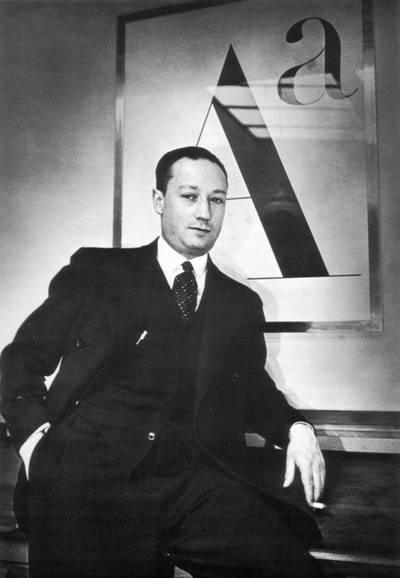
Charles Peignot
The Association Typographique Internationale was founded in 1957 through the vision and energy of Charles Peignot, president and general director of the Deberny et Peignot type foundry in Paris. Other key figures in the creation of ATypI included John Dreyfus, typographic advisor to the Monotype Corporation; Gerrit Willem Ovink, aesthetic advisor to Lettergieterij Amsterdam; and Me. Guido Poulin, the French attorney whom Peignot engaged to be the association’s legal representative.
Deberny et Peignot was in the business of manufacturing metal type for hand-setting; it was one of the two most important type foundries in France (the other being Fonderie Olive in Marseille), having absorbed many of its competitors over the course of its century-long history. Under Charles Peignot’s guidance since the 1920s, D&P had become a force in developing types that reflected and embodied the spirit of Modernism, notably the radical display face Bifur and the unique typeface that bore Peignot’s own name.
Charles Peignot had become de facto head of the Deberny et Peignot foundry after both his father and his brothers were killed in the First World War. In the 1920s and 1930s he was very active in promoting the role of typography in modern culture (notably through his creation and direction of the design journal Arts et métiers graphiques, which ran until 1939). It wasn’t until 1952, however, after the Second World War and France’s recovery from the German occupation, that he took over as President and General Director of Deberny et Peignot.
One of Peignot’s early decisions was to give full support to the new, potentially disruptive technology of phototypesetting, by becoming the French distributor of the Lumitype/Photon phototypesetter. (Although the Lumitype had been invented in France, it was in the United States in the 1940s that its inventors found the backing they needed to develop it. Charles Peignot’s support brought this French invention full-circle back to France.) Part of Peignot’s motivation was his disappointment at the way his father, Georges, in the pre-WWI era, had refused to take part in the move to hot-metal machine typesetting; Charles did not want to miss the next technological revolution.
It was Charles Peignot’s forward-looking approach to the type business that gave him the conviction that it was necessary to create an international typographic body. As Alfred Hoffman, who was ATypI’s treasurer almost from the beginning, put it: once Peignot saw the potential of the Lumitype and how it was going to change the type industry, “he found that manufacturing type had suddenly become much easier, but that typefaces could be copied easily too, so something had to be done about it. It’s actually very commendable that a man like Charles Peignot — a grand seigneur and all that — was clever enough to say that we need to dream up a way to protect typefaces on an international basis.”
Protecting type designs
ATypI’s initial plan for protecting the design of typefaces was ambitious: to influence the international bodies that governed the protection of industrial design to add type design to the categories officially recognized throughout the world.
In particular, Charles Peignot hoped to bring typeface protection under the umbrella of the Hague Agreement, which governed the international registration of industrial designs. “First adopted in 1925, the Agreement effectively establishes an international system — the Hague System — that allows industrial designs to be protected in multiple countries or regions with minimal formalities.”
U.TYP.E
At first, they called this proposed organization the European Typographic Union. It seemed enough, perhaps, to attempt to corral the various countries of Europe with their typographic and printing industries and traditions into one organization.
In an initial proposal for the new association, they gave it the provisional title of a European Center of Typography, and explained the reasons for such an organization. They expected a fundamental change in the type industry because of the introduction of phototypesetting [trans. JDB]:
The moment when film is replacing casting in lead is certainly as momentous as the moment when lead casting replaced wood engraving. […] The very structure of the printing profession may be changed by this. Whether the craft survives these changes will depend on the professionals themselves.
While they anticipated that phototypesetting would lead to an increase in the amount of type being set and the number of printed pages, they warned that this “ease of creation” would inevitably degrade the craft of typography and would make copying of type designs much easier. “As they threaten the Art, they also threaten the artists.”
John Dreyfus, who later became ATypI’s second president, was actively involved from the very beginning. Peignot had sent Dreyfus the proposal in June 1955, along with “extracts” of a proposed constitution for the Union Typographique Européenne (“U-TYP-E”) and a letter setting out Peignot’s reasoning and asking for suggestions of other people in the type world who ought to be invited to participate.
Dreyfus replied to Peignot’s letter: “I am very flattered to receive your letter CP/JD of 14 June concerning a ‘Centre Européen de Typographie’. You ask me for a quick reply, and your scheme deserves prompt attention; but I must make it clear that the opinion I give in this letter represents my personal belief, and that I have not consulted either Crutchley (who is away) or the Monotype Corporation.” (Brooke Crutchley was printer to the University of Cambridge, where Dreyfus was also an advisor.)
Even if the Americans had not created a National Board on Printing Type Faces, I would have been in favour of supporting your proposed Centre; but the American move surely means that we must create a European counterpart. In my limited experience, I have found that typefounders are surprisingly willing to co-operate with each other, although their eagerness to do so is often dampened by the practical difficulties created by fiscal or customs difficulties. I therefore have limited hopes of the practical advantages of the Centre which you propose, but I am optimistic that the aesthetic side (which you have always been ready to champion) will receive a welcome impetus by the creation of your Centre. At the same time, your Centre might be the means of compiling vital international statistics, which we sorely lack, concerning the sales of types, international preferences in styles, sizes etc. Discussions at Lurs have proved that those who are interested in classification are not necessarily incapable of creation.
“Discussions at Lurs” is a reference to the annual gathering of artists, writers, photographers, publishers, and graphic designers known as “Les Rencontres internationales de Lure,” which was held each year in the remote village of Lurs-en-Provence. The Rencontres [encounters or meetings] were founded in 1952 by Maximilien Vox, to give creative people an opportunity to get away from their everyday jobs and discuss the deeper ideas behind their work. (Confusingly, “Lurs” is the name of the village, while “Lure” is the name of a nearby mountain. They are not homophones; the ‘s’ of “Lurs” is pronounced.) Vox was a multi-talented writer, cartoonist, illustrator, publisher, journalist, critic, art theorist, and typographic historian; in 1954 he had created his own system for classifying typefaces in the Latin alphabet, which was later adopted by ATypI (1962) as the “Vox-ATypI classification.”
Dreyfus had known Vox, Peignot, and many of the other luminaries of the French typographic scene through these regular francophone events in Lurs. (Dreyfus spoke and wrote fluent French; Charles Peignot was not fluent in English.) It was natural that Dreyfus was one of the first people to whom Peignot broached the idea of a new organization.
Reaching out to the type community
Dreyfus supplied Peignot with a list of “10 European typographes who I consider would be the best qualified to assist you in settling the framework and policy of the Association.” He also recommended that Peignot approach an experienced international lawyer, “if only to preserve diplomatic relations between yourself and the difficult characters whose names are set out in my list. I have chosen them for their knowledge, rather than for their amenable natures.”
The ten people suggested by Dreyfus were:
– Stanley Morison
– Konrad Bauer
– G.W. Ovink
– Walter Tracy
– Jan van Krimpen
– Giovanni Mardersteig
– Jan Tschichold
– Max Caflisch
– Roger Excoffon
– Hermann Zapf
Peignot suggested a meeting of interested parties in London, “on the occasion of the exposition of graphic industries in July,” and he said that he would “do the impossible to make the necessary contacts with them.”
At least two of those approached must have given a positive response: Stanley Morison, Dreyfus’s predecessor as typographic advisor to Monotype and to Cambridge University Press, and Jan van Krimpen, the noted Dutch type designer, typographer, and book designer. In a form letter dated 30 May 1956, presumably intended for other potential members, Peignot wrote (as translated into English by John Dreyfus):
Messrs Stanley Morison, van Krimpen and I have given consideration to a scheme of some possible interest — the creation of a European Association with the title Union Typographique Européenne or ‘U-Typ-E’.
He included an extract from the draft statutes, and invited potential members to meet in Paris, at the time of the Salon International des Techniques Papetières & Graphiques in June, for a “general constituent assembly.”
The “extract” listed five goals for the new association [trans. JDB]:
1: to present to the European manufacturers of phototypographic machines the trends and aspirations of the different national markets;
2: to organize themselves against copying and to establish for themselves a code of authors’ rights with the intention of getting the principles, if not the terms, internationally adopted as an official basis for copyright legislation in the matter of typographic Art;
3: to establish relations with all organizations and groups that are proposing similar goals or annexes, and notably with the National Board on Printing Type Faces;
4: to bring about any event that is likely to develop critical knowledge of traditional global Typography in the public;
5: to create a center of international typographic documentation.
First preliminary meeting | Paris 1956
Thirty leading figures in the field of printing and the graphic arts gathered in Paris in June 1956 to consider forming a non-profit “International Typographical Union.”
The object of this Union would be to unite all those who, being professionally concerned with the art of typography, are agreed upon the need to keep the art alive, and to protect its basic principles against the development of new techniques which might threaten them. The Union would co-ordinate the ideas of its members and give effect to their wishes.
These were the goals enumerated for the new organization:
Strengthening the bonds which already exist between the persons referred to above.
Opposing infringement of copyright by every measure afforded under the Berne Convention and establishing amongst its members a code of authors’ rights, with the intention of getting this recognized and internationally adopted as the foundation of official legislation which will establish the authors’ rights in typographical material.
Establishing rules of procedure for arbitration in typographical material.
Ensuring that there is throughout the world contact and liaison between all organizations and associations with similar aims.
Creating an international centre of typographical documentation.
Setting up amongst its members an information centre, capable of co-ordinating their activities, so as to avoid losses which might arise from individual efforts made in ignorance of what is being done by others.
Placing its services at the disposal of members for the protection of their interests.
Acting as arbitrators in lawsuits which might arise between members, or to refer them to a third party outside the Union.
Finally encouraging various activities: exhibitions, publications, films, discussions etc., which will foster in the public a critical appreciation of typography.
The association was not officially launched at that meeting, but the ground rules were established, and the group established a Provisional Committee to draft statutes and prepare for a Constitutive Assembly.
Second preliminary meeting | Geneva 1956
The Provisional Committee held its second organizational meeting in Geneva on 25 October 1956. The proposed organization’s name was still “Union Typographique Internationale.”
The committee members present were Stanley Morison (President) and Walter Tracy, representing England; Charles Peignot, representing France; Jan van Krimpen and Gerrit Willem Ovink, representing the Netherlands; Piero Capitini and Luigi Colombini, from Italy; and Georges Corbas and André Kündig, from Switzerland; along with the lawyer Maître Guido Poulin, who had drawn up proposed statutes for the organization. (John Dreyfus from England and Maximilien Vox from France were unable to attend and sent their apologies.)
The committee agreed to prepare an announcement of their intentions, to have it translated into English, German, Italian, and French, and to have it sent to the trade papers of each participating country for dissemination as news. The committee also “unanimously requested Mr Charles Peignot to approach such German trade organizations as were likely to be interested in our plans,” asking them to nominate one of their members to the Provisional Committee and “to take part in the first General Assembly as founder-members.”
A new name | 1957
The proposed name of the new organization went through several iterations. What had begun as the “European Typographical Union” (Union typographique européenne) ended up officially as the “International Typographical Association” (Association typographique internationale). This expansion beyond Europe was primarily aimed at including representatives of the print industry in the United States.
There was another problem with calling the organization a “union.” In a letter to John Dreyfus on 14 March 1957, P.J.W. Kilpatrick, one of the directors of T. & A. Constable Ltd., printers to the University of Edinburgh, pointed out a potential conflict.
Whilst the objects of this Union seem to be to be excellent, it seems unfortunate that the English title will coincide with the American Trades Union covering compositors in U.S.A. and Canada, which bears the same title and is normally known as the I.T.U.
Kilpatrick suggested changing the name to the International Union of Typography (or Typographers), to avoid confusion.
Dreyfus’s reply was sent the very next day, informing him that the name had indeed been changed. Kilpatrick seemed satisfied, though he had some further thoughts on names.
You ask my views on the title International Typographical Association, and I personally think that there might be some confusion with the T.A. I am surprised that you are keeping to the term Typographical and would have thought you might have preferred Typographers, using some such title as the International Society of Typographers or the International Association of Typographers, but this is not really a point on which I am very much concerned, my only anxiety being to avoid confusion with the existing body.
Even after the association’s name had been settled on, we can see that its accepted abbreviation has varied over the years. Initially it was common to refer to the association as A. TYP. I. or A.TYP.I. (with or without spaces), with all the letters capitalized. Various logos have played with the arrangement over the decades, of course. (Dreyfus had originally been asked to design a logo or monogram for the association, though there never appears to have been an official mark.) In recent decades, the abbreviation has standardized as “ATypI,” sans punctuation and in mixed case, with only the initial letters of the three words in caps.
First general meeting | Lausanne 1957
Peignot’s efforts came to fruition when the Board and members of the new association met for the first time on 11 June 1957. This was the inaugural meeting, held during the Graphic 57 exhibition and the International Master Printers Conference in Lausanne. Presumably many of the members would have been planning to attend already, and Swiss printer Georges Corbaz arranged for meeting space at the Hôtel de la paix on two successive days (10 June, a meeting room for 15 people; 11 June, a room for 100 people). Corbaz presided over the inaugural meeting. The second day marked the official date of the birth of ATypI.
“At the inaugural meeting of the Association on 11th June, 1957, the President declared:” [trans. presumably John Dreyfus]
The Association proposes to unite internationally typographical creators, artists, manufacturers and personalities of the graphic industries who, on the plane of strict ethics, respect amongst themselves the rights of property conferred to them by initiative and the talent of typographical creation.
The means for protecting ourselves exist, notably through the medium of the convention at BERNE which grants — rightly — protection to several creations in the domain of industrial or decorative art; but we must mention that typography is an esoteric art and the tribunals of certain countries can be more or less well informed about it; it is the duty of the Association to inform the tribunals on the merits of any works susceptible of being protected.
The International Typographic Association does not intend to be a substitute for existing organizations by directing the action already undertaken by some of them; it definitely does not want to risk compromising by an inconsiderate intervention the excellent results already obtained in certain countries; but it is there to give opinion, to supply reports, to offer advice if required.
The minutes of the Board meeting (“Réunion du Conseil d’Administration”) record the following members being present: John Dreyfus, Maurits Enschedé, G.W. Ovink, Charles Peignot, A.G.E. Van der Tuuk, Walter Tracy, Pierre Verbeke, Maximilien Vox, and Hermann Zapf.
The inaugural general meeting (“Assemblée Générale Constitutive”) made nominations for the Board of Directors, with their respective countries:
– Germany: Ernst Vischer, Hermann Zapf
– England: Jack Matson (Monotype), John Dreyfus
– Belgium: Pierre Verbeke
– France: Charles Peignot, Maximilien Vox
– Holland: Maurits Enschedé, G.W. Ovink
– Italy: Donato Cattaneo
– Scandinavia: Bror Zachrisson
– Switzerland: Ed. Hoffmann (Haas foundry), André Kündig (printer, Geneva)
– U.S.A.: American Typefounders, Intertype, Walter Tracy (Linotype), Hunter Middleton (Ludlow), A.G.E. Van der Tuuk
Information Bulletin No.1
ATypI’s first official publication was the Information Bulletin №1, dated October 1957, which reported on the official launch of the Association. “Since the Inaugural General Meeting at Lausanne, the routine formalities of registering the Association and its statutes have been carried out.” One of those routine formalities was to establish the registered office of the Association in Geneva, although the bulletin explained that correspondence should be addressed to the President, Charles Peignot, in Paris (“or to the Delegates of the Association in each country”).
Several “provisional Delegates” for participating countries are named:
– Belgium: Pierre Verbecke
– Czechoslovakia: Method Kalab
– Denmark: Jokum Smith
– England: John Dreyfus
– France: Charles Peignot
– Germany: “corresponence should be addressed provisionally to the President” (i.e., Charles Peignot)
– Holland: Jan van Krimpen
– Italy: Piero Capitini
– Sweden: Bror Zachrisson
– Switzerland: Georges Corbaz
– U.S.A.: Anthony van der Tuuk
Organization
The October 1957 bulletin also explains that “The Board of Directors met at Amsterdam on 31 July and took certain decisions,” which it goes on to list in detail. Delegates were asked to translate and arrange for the printing of the statutes (with a precise printed format specified), along with a Form of Application for Admission. The rest of the decisions had to do with membership and with committees.
Membership was open to “Personalities in the Graphic Trades,” whether individual or corporate. Certain “qualifications” were required before the Board would approve membership; applications would be submitted through the national delegate of each country, then the national delegates would propose new members from their countries.
The criteria for membership were spelled out in a “Lettre aux délégués” (Letter to the Delegates) dated 14 October 1957. [trans. JDB]
1. No objections on the level of morality and honorability.
2. Evidence of a real interest in Typography.
3. Right to be considered as belonging to one of these categories (specify the category):
A) Typefounders;
B) Manufacturers of typesetting machines (lead, film)
C) Type designers
D) “Personalities” (person or company) of the Graphic Professions.
These categories reflected the composition of the type industry and the people in it. Membership might take different forms depending on the professional nature of the member, whether individual or corporate.
The annual rates for membership seem to have been a matter for debate from the start. Under the heading “Subscriptions from Industrial Concerns,” the bulletin explains:
The Board has ruled that the scale indicated for fixing annual membership fees according to the number of persons employed in designing, engraving, casting, matrix-making, etc., is to be considered as a guide which permits each society to settle according to its own conscience and special circumstances, the exact membership fee which it will pay for the first year.
This topic had already come up in the preceding May, when John Dreyfus expressed his worry, in a letter to Charles Peignot, that the proposed fees for “personnes morales” (corporate entities) might be too high, and that some companies would try to get around the rules by simply arranging for one of their directors to become an individual member, thus defeating the purpose of corporate membership.
Committees
The Board set up four “special committees”:
Committee to study the creation of type faces: The object of the first committee was: “To define what constitutes originality in the creation of a type face — when it falls into the public domain — copying and influence — limitations upon the rights of reproduction in the purchase of type faces.” Its members were John Dreyfus, Walter Tracy, and G.W. Ovink.
Committee concerned with creative work in Typography: The typography committee concerned itself with “The problem of originality in typographical layouts, and of their protection.” The members were Jan van Krimpen, Hans Schmoller, and Leo Lionni.
Legal committee: The “legal” committee seems to have consisted entirely of Me. Poulin, the Association’s legal advisor, who was charged to “gather together documents concerning the Association’s problems and to submit to the Board of Directors the names of the most competent people who might be appointed to this Committee.”
General Activities committee: Finally, the “general activities” committee’s job was, in essence, everything else: “To draw up a programme of activities which would serve to further the ends of the Association — Exhibitions — Publications — Lectures etc … [ellipsis in the original] and the creation of an international information centre, concerned with typography.”
Narrowing the focus
The goals of the association were ambitious and far-reaching – too far-reaching, according to some. At a meeting in London in November 1957, the management committee decided that it would be best to focus the new organization’s attention first on type protection, and leave the “general activities” for later.
The management committee consisted of the President, Charles Peignot; Stanley Morison; Maximilien Vox; John Dreyfus; Walter Tracy; Maître Poulin (the Association’s legal representative); and Jack Matson.
Adding new members
The management committee kept trying to recruit more members for the association.
In a February 1958 letter to Anthony G.E. Van der Tuuk, President of Amsterdam Continental in New York, Charles Peignot thanked Van der Tuuk for getting Amsterdam Continental to join ATypI. Peignot confirmed that other members now included the three Linotype companies (English, German, and American) and both English and German Monotype companies, while Jack Matson of Monotype was working on getting the American company Lanston Monotype on board. Peignot said that they were still missing American Typefounders (ATF), Ludlow, and Intertype, as well as various smaller American foundries that might eventually decide to join. (In a postscript, Peignot reported that ATF had in fact agreed to join.) He also hoped that an American event that year, the Typographic Seminar at Silver Mine, would prove a fertile recruiting ground for ATypI, especially among the members of the Typophiles of New York, who would probably be in attendance.
Second general meeting | Düsseldorf 1958
ATypI held its second annual Assemblée Générale (general meeting) in Düsseldorf, on 6 May 1958, during the DRUPA exhibition (again, taking advantage of an existing event of interest to the printing industry).
In order to further the protection of type designs, ATypI proposed the establishment of a registry of new typefaces, where designers and manufacturers could deposit evidence of their new designs and thereby establish their rights. But since different countries had different legal standards for industrial design, ATypI adopted a resolution to “make a joint effort in all countries concerned to standardise formalities for depositing a design so that A.TYP.I. members can be assured that they have a legal right to claim protection.”
A committee was established to study the thorny problem of typeface registration, and to establish standards for what constituted an original design.
There was a diplomatic conference scheduled for later that year in Lisbon, with the purpose of re-examining and revising the 1925 Hague Agreement on industrial design. ATypI, in its role as expert advisor, saw this as an ideal occasion to raise the subject of international protection for typefaces. In a press release, ATypI reported: “Delegates from various countries have been briefed by leading members of A.TYP.I. on the need to place the problem of type design protection on the agenda of the conference.”
ATypI’s efforts got extensive coverage in printing journals internationally (no doubt due to the efforts of the wonderfully named Committee on Propaganda and Public Relations), initially in 1957 and more extensively in 1958 with reports on the Association’s growth, membership, aims, and policies. A scrapbook of news clippings in the ATypI archives shows newspaper articles from Belgium, Canada, Australia, South Africa, and India, as well as many from London and Paris.
Progress & growth
The year 1959 saw the growth of the Association and slow but apparently steady progress on obtaining type-design protection from international standards bodies.
It also saw the loss of one of ATypI’s founding members, Jan van Krimpen, who died in October. Van Krimpen had been given the title of Vice-Président d’Honneur (honorary vice-president). This was a purely honorary title, acknowledging the recipient’s high reputation in the typographic world. Stanley Morison was Président d’Honneur and Giovanni Mardersteig was the other Vice-Président d’Honneur.
Although one member company — Intertype — quit ATypI early in the year, Peignot could celebrate, at the General Meeting in Paris on 30 November, “the massive support of the large German, English, and Swiss foundries.” After listing the new member foundries by country, Peignot went on: “Without doubt our efforts, our perseverence, our first results have inspired our colleagues and taken away their skepticism. Their addition confers more authority on our Association and also reinforces our means of action.” This increased membership led to an increase in the number of foundries represented on the Committee on the Creation and Protection of Typefaces. The Board of Directors also increased in size as more countries and more businesses and individuals joined ATypI.
Both the type-design committee and the legal committee worked on aspects of the proposal to set up a typeface registry. It was not a straightforward matter. As Wolfgang Hartmann of the Bauer foundry pointed out, it would be difficult to go back and register the designs of already existing typefaces; yet they were just as susceptible to being copied as were new designs. And creating a registry within ATypI was dependent on what the Association could accomplish in the realm of international protection.
Although there had been a proposal, at the 1958 general meeting in Düsseldorf, to incorporate such a registry into the statutes of the Association, by the time of the 1959 general meeting in Paris the type-design committee had reversed course: it was recommending instead that, until the legal situation was resolved, any registry should be purely an internal policy of ATypI, not enshrined in the statutes.
In the legal realm, Me. Poulin reported that in 1958 ATypI had asked the Lisbon conference to consider a “special arrangement” (under Article 15 of the Convention d’Union de Paris of 20 March 1883) “concerning the international protection of printing types, designs, and graphic marks.” The Lisbon conference decided to convene a special meeting in The Hague in 1960, which would be devoted entirely to modifications to be made to the Hague Convention. In preparation for that, in September 1959, also in The Hague, there would be a Conference of Experts to study potential revisions to the Convention; and ATypI had been invited as an observer to that meeting.
Among the revisions being considered was opening up membership to Great Britain and the United States, and potentially to all the member states of the United Nations. “In the opinion of the majority of the European participants,” Me. Poulin reported, “it will be necessary to establish special conventions to offset the effects of the general Convention. This evolution seems very favorable to the ideas of our Association. … The preparatory Conference of Experts of the Hague has officially recorded our desire.” The complexities of navigating the waters of international regulatory bureaucracy were byzantine.
Poulin said that the legal committee suggested that ATypI prepare its own pilot study of a revised international convention, and circulate it to the national delegates to the 1960 conference in The Hague. “If four or five of the most interested countries give their assent,” Poulin said optimistically, “the special Convention could be a reality next year.”
The legal committee reported that, in a related development, the British government was in the process of creating a commission to consider and study “all the problems of artistic and industrial protection and the rights of creators in this matter,” which of course ATypI would very much encourage and support.
In October 1959, ATypI’s Board of Directors officially established the position of “Secrétariat Administratif,” which “had not really existed in any precise fashion” before. The position was filled by Mme Hella Dommergue, a German who was fluent in French, English, and German.
At the same time, Alfred Hoffman joined the Board and replaced André Kündig as Treasurer, a position he would hold for many years. He was ably assisted over much of this time by his secretary, Frau Roswitha Jung.
Type classification
At the 21 July 1959 meeting of the management committee, Dr. Franz Gerhardinger brought up the subject of the Vox Classification, which had been created several years before by Maximilien Vox as an overall structure for classifying typeface designs both historically and structurally. (The Vox Classification concerned itself only with the Latin alphabet, with its primary focus on the development of serif typefaces for text.) Peignot said at that meeting that perhaps the time had come for the Association to “bring together all the elements of the problem to try and promote a classification that could be adopted internationally.”
At the Board meeting on 10 October, Peignot reported that the Vox classification system had sparked interest in similar studies in Germany and England. “If the Association allows it to happen, we will soon find ourselves faced with three new classifications that will be perhaps a little better on the national level, but surely quite incoherent on the international level.” Peignot suggested therefore that ATypI should create a fifth committee to study this problem and to propose a new classification system using the clearest possible terms, perhaps even entirely new terms. “This classification, once it has been ratified by the General Assembly, will be considered as the sole official international classification.” The Board established a new Typeface Classification committee, chaired by Maximilien Vox, with G.W. Ovink, Walter Tracy, and Hermann Zapf as members.
Priorities
Although the Management Committee had decided in 1957 to limit the Association’s immediate activities to typeface protection, after two years this consensus was no longer universal.
Peignot made a trip to the United States in the spring of 1959, where among others he met with Jackson Burke, Typographic Director of Mergenthaler Linotype, in New York. Burke seemed to be generally in favor of ATypI, but he definitely felt that the Association ought to get itself well established before taking on any tasks beyond typeface protection. At the same time, Aaron Burns, the new delegate for the U.S.A., was pushing for the creation of an International Typographic Centre (more formally, a Centre for International Typographic Information and Documentation) under the auspices of ATypI in New York. Along with Vice-President Van der Tuuk, Burns proposed changes to the organization of ATypI that would permit the establishment of national organizations under ATypI’s umbrella.
As Peignot reported, this proposal for a typographic centre was quite the opposite of what Jackson Burke was advocating. “But we must not have too many illusions on this point. In fact, this problem [type protection] only interests a very limited number of people.” He asked Van der Tuuk to present more information on the proposal at the Board meeting in November.
At that meeting, the Board concluded that, “considering the early results obtained in the domain of typographic protection, the time has come for ATypI to turn its attention to the other objectives defined in Article 2 of the Statutes.” In other words, to take on its educational role in the world.
In its report to the General Meeting, the Committee on Propaganda and Public Relations said that its main goal would be “to set up a more extensive press service for the Association.” But, they added, “it must be pointed out that this will only be possible if the Association itself sanctions a certain number of activities that are more likely to interest the public than the important but somewhat abstract problem of protection.”
At this same General Meeting, Aaron Burns joined the Committee on Propaganda and Public Relations.
A.TYP.I-U.S.A.
Aaron Burns had an ambitious plan for establishing a national subsidiary of ATypI in the United States, A.TYP.I.-U.S.A., and for creating an International Center for the Typographic Arts, which would showcase and promote all forms of graphic communication. At first, after meeting with Burns, Peignot gave him “carte blanche” to go ahead with his plans. Burns accordingly spent several months of his time, and several thousand dollars of his own money, on setting up a fairly complex organization, with regional chapters and a hierarchy of officers and representatives, and in July 1960 he sent out two hefty progress reports detailing everything he was doing.
Those many-page reports may have given Peignot cold feet; or he may simply have thought better of it. In any case, he apparently changed his mind and abruptly withdrew his support for the American project. This caused considerable disruption and a flurry of anguished correspondence, with Burns ending up resigning from the project.
Some of the Board members supported Burns and were dismayed by Peignot’s volte-face; others, though not happy about the way things had gone, felt that what Burns had proposed was too ambitious and not really consonant with the basic aims of ATypI. This seems to have been the end of the idea of national organizations within ATypI.
It was not the end of Aaron Burns’s efforts, however. He did in fact establish an International Center for the Typographic Arts in New York, independent of ATypI. In 1964 the ICTA organized the first of a projected series of international exhibitions of typographic design, “Typomundus 20,” with a distinguished jury and a landmark book that came out of the exhibition. Burns’s aim was expansive: to celebrate the whole range of graphic communication and typographic arts. The focus of ATypI remained on trying to secure protection for type designs, and in a larger sense on the needs and interests of type foundries and related industries.
In March of 1961, John Dreyfus wrote to Charles Peignot expressing his opinion on what ATypI should be doing. “The more I think about the future of A.Typ.I., the more I think it desirable that we should concentrate upon achieving international protection, with a limited membership.” He said he had discussed this with Stanley Morison, who was “emphatically of the same opinion.” They felt that typography was not the proper subject for ATypI, but rather type design and the business of manufacturing and selling type. “In short,” Dreyfus wrote, “I would prefer to see A.Typ.I. concentrate its energies upon affairs which are not already dealt with seriously by existing organisations.”
A quixotic effort
Charles Peignot’s goal in establishing ATypI had been to bring the leading figures of the type world together. Against the odds, and despite the oddities of many who were initially skeptical, he managed to do it.
Peignot was prescient about the effects of new technologies on the business of type, but he was overly optimistic about the prospects of gaining international support for the protection of type designs. ATypI participated in many international meetings from its founding until the Vienna Conference in 1973, which actually produced the Vienna Agreement for the protection of type. But these efforts proved largely futile. The Vienna Agreement was never ratified by more than three countries; to come into effect it required at least five.